
Buying Guide · Guangzhou Beauty Supply Chain
Airless Pump vs Standard Lotion Bottle: Packaging Compatibility & Leakage Test Standards
Compare airless pumps and lotion bottles. Review formula compatibility, leakage test scopes and the supplier evidence to request before packaging approval.
An airless pump bottle and a standard lotion pump bottle can look almost identical on a sample shelf, yet the dispensing systems inside behave very differently. That difference affects air exchange during use, product evacuation, filling, transport performance and cost. For a cosmetics buyer, the useful question is not whether airless packaging is “better.” It is whether the formula needs that system and whether the finished pack can pass compatibility, dispensing and transport checks.
Airless packaging can be an excellent choice for treatment creams, serums and formulas where reduced air exposure matters. A conventional lotion pump may be the more practical choice for body lotions, cleansers, shampoos and many everyday personal-care products. The decision should come from the formula, user experience and distribution route—not from the word “airless” in a catalogue.
Airless Pump vs Lotion Pump Bottle: Quick Comparison
The figures below are useful for supplier screening and RFQ preparation. They are not universal operating limits or pass/fail standards: the approved values must belong to the selected pump, the actual formula and the intended distribution route.
| Evaluation criterion | Airless pump bottle | Standard lotion pump bottle |
|---|---|---|
| Dispensing structure | Typically uses a rising piston, collapsing pouch or another airless mechanism; usually no conventional dip tube | Typically uses a vented pump and dip tube, with air entering the headspace as product is dispensed |
| Viscosity screening reference | 5,000–50,000 cps can be used as an initial screening band for selected cream and serum systems; some purpose-built pumps handle higher viscosities | 1,000–15,000 cps is a practical initial screening band for many lotion pumps; the workable range changes with the pump engine, orifice and formula rheology |
| Air exposure and preservation | Reduces repeated air exchange and may support formula protection. It does not by itself justify reducing preservatives | Replacement air commonly enters through the venting system. Formula stability and preservation still require validation in the finished pack |
| Evacuation and residual product | <3% residual may be set as a buyer acceptance target for a qualified system, but it must be measured with the actual formula | 5–15% residual is a sourcing assumption, not a guaranteed range; bottle geometry, dip-tube cut and formula flow can change the result substantially |
| Filling and priming | May require bottom-fill/top-fill instructions, headspace control or model-specific priming procedures | Usually familiar to more filling lines, but torque, dip-tube length, actuator lock and initial priming still need control |
| Vacuum-test starting point | -0.08 MPa for 15 minutes can be written into an RFQ as a project-specific screening condition only when the supplier or laboratory confirms the method and package suitability | -0.05 MPa static can be a project-specific screening condition, but it should not be treated as the default standard for every threaded or snap-on lotion pump |
| Evidence to record | Formula version, package and pump model, sample quantity, fill level, orientation, temperature, pressure reference, duration and an objective failure definition | |
| Typical commercial fit | Treatment skincare, premium creams and serums where reduced air exposure or high evacuation supports the product brief | Body lotion, cleanser, shampoo, hand wash and many mainstream skincare or personal-care products |
| Cost and sourcing | More components and tighter process control usually mean a higher comparable pack cost | Simpler construction, broad component availability and generally lower comparable cost |
How to use the figures: treat the viscosity bands, residual percentages and vacuum levels as RFQ starting points to be confirmed—not catalogue guarantees. ASTM D4991-25 covers differential-pressure leakage testing of empty rigid containers; it does not prescribe a universal cosmetic-bottle setting. A specific Aptar airless system, for example, states 90%+ evacuation and ultra-high-viscosity use, which demonstrates why performance claims must remain model-specific. Cosmetics Europe stability guidance also calls for evaluation in packaging representative of the final marketed pack.
Both formats require evidence. Appearance, supplier claims and an empty sample are not enough for approval.
How an Airless Pump Bottle Actually Works
A conventional lotion pump normally uses a dip tube extending toward the bottom of the bottle. Pressing the actuator draws product through that tube. As product leaves the bottle, air typically enters the headspace. An airless system works differently. Many airless bottles use a piston at the bottom of the product chamber. As product is dispensed, the piston gradually moves upward. Other airless systems use a flexible inner pouch that contracts as the contents are removed. There is usually no conventional dip tube.
This architecture can reduce repeated contact between the bulk formula and incoming external air during use. It can also help push more product toward the dispensing mechanism. That is why airless packaging is common in premium skincare. But there is an important qualification. “Airless” does not mean that the package contains literally no air, nor does the name itself guarantee zero oxidation, zero contamination, zero leakage or a longer shelf life.
Those are performance questions that need evidence from the specific formula-and-package combination.
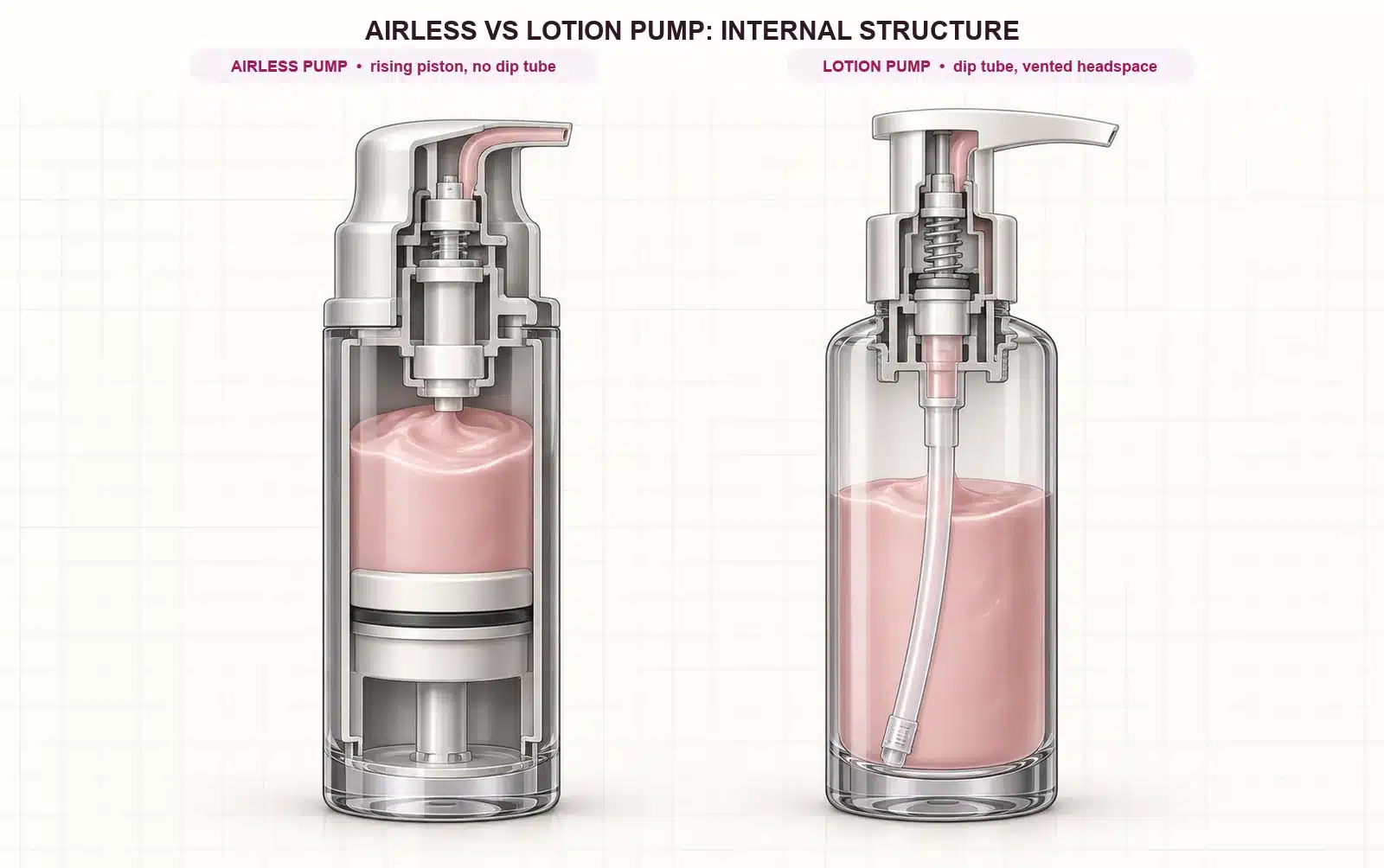
Aptar’s explanation of airless technology makes the same distinction: airless systems are designed to provide higher formula protection and strong product evacuation, but compatibility still depends on the particular system and formulation.
When airless packaging earns its place
Airless should solve a real product or commercial problem. If it does not, the extra complexity may simply be extra cost.
Airless is worth considering when formula protection matters
A skincare developer may prefer an airless format when repeated air exposure is undesirable for the formulation. This can be relevant to certain:
- treatment serums
- facial creams
- eye products
- premium moisturizers
- low-preservative formulations
- formulas containing ingredients with particular stability concerns
That does not mean every vitamin C, retinol, peptide or “natural” formula automatically requires an airless bottle. Ingredient lists alone are not enough to make that decision. The formula manufacturer should review the actual formulation, stability data, packaging contact materials and intended shelf life.
Airless can also improve the end-of-pack experience
One frustration with a conventional pump bottle is the product that remains around the bottom corners or below the reach of the dip tube. A well-matched airless system can improve evacuation because the product chamber changes as the formula is dispensed. This matters commercially. Consumers do notice when an expensive skincare bottle appears “empty” but still contains a visible amount of cream. However, do not approve an airless pack because a catalogue claims a particular evacuation percentage. Test the intended formula.
A thin serum, a rich cream and a high-viscosity sunscreen may behave very differently in the same dispenser.
Premium positioning is another legitimate reason
Packaging is part of the product experience. Airless systems can provide:
- controlled dispensing
- a clean pump presentation
- premium proportions
- double-wall or glass-like aesthetics
- refillable configurations
- metal-free product pathways on selected systems
- extensive decoration options
For a facial treatment retailing at a premium price, this can make sense even when a standard pump might technically dispense the formula. Packaging is not chosen on engineering criteria alone. Brand position matters too.
When a standard lotion pump is the better choice
There is a tendency in beauty packaging to describe airless as the “advanced” option and everything else as a compromise. That is too simplistic. A standard lotion pump has one major advantage: it is a mature, versatile and widely available packaging format. For many products, that is exactly what a brand needs. Consider a conventional pump first for products such as:
- body lotions
- hand lotions
- cleansing products
- liquid soaps
- shampoos and conditioners
- massage products
- some facial moisturizers
- other formulas for which enhanced air-exposure control is not a key packaging requirement
A standard system may also make more sense when the project has a tight packaging budget, a large fill size or a requirement for straightforward sourcing across different suppliers. There are usually more combinations of bottles, neck finishes, pumps and decoration routes available. And because the structure is less complex, it can be easier to troubleshoot. That practical simplicity is often valuable.
For a 300 ml body lotion, for example, spending more on an airless system may create little consumer value if a properly selected standard pump already provides reliable dispensing, acceptable stability and good product evacuation. Do not pay for packaging technology simply because it sounds premium.
Pay for it when it solves something.
Formula compatibility matters more than the bottle name
This is where packaging selection becomes more technical. A bottle can look perfect in a showroom and still be unsuitable after it is filled. Compatibility is not just a leakage question. It is the relationship between the formulation, the components that touch it, the package structure and time. Possible problems include:
- discoloration
- odor changes
- viscosity changes
- swelling or distortion of components
- stress cracking
- loss of seal integrity
- sticking or inconsistent pump action
- formula buildup around the actuator
- poor priming
- reduced output
- unexpected interaction with seals or other wetted components
Cosmetics Europe stability guidance recognizes that packaging can affect finished-product stability through interactions between the product, the container and the external environment. That is why representative final packaging should be part of stability evaluation.
Ask what actually touches the formula
“PP bottle” or “PET bottle” is not enough information for a serious compatibility review. For a pump package, the formula may contact several components. Depending on the design, these could include:
- bottle or inner pouch
- piston
- valve components
- pump chamber
- gasket or seal
- actuator pathway
- internal spring-area components, depending on construction
Ask the packaging supplier for a component specification or material declaration identifying the product-contact pathway. For airless packaging in particular, it is useful to ask whether the product pathway contains metal and whether alternative configurations are available when formula compatibility requires them.
There is no universal “best viscosity” for an airless bottle
Buyers often ask suppliers: “What viscosity can this pump handle?”
It is a sensible question, but the answer should not be treated as a universal rule. Different airless systems are engineered for different products and dispensing outputs. Commercial systems can support a broad range of viscosities, but the applicable range belongs to the individual pump design. More importantly, viscosity alone does not describe how a cosmetic behaves during dispensing. A formula’s flow characteristics can change with:
- temperature
- shear
- formulation structure
- air content
- filling conditions
- storage time
A cream that pumps correctly immediately after filling can behave differently after several weeks of storage. So rather than asking only: “Can this bottle handle 30,000 cps?”
ask: “Has this exact formula been tested in this exact pump system?”
That second question is far more useful.
Airless does not automatically mean leak-proof
This is one of the most common assumptions in packaging sourcing. An airless bottle can leak. A standard pump bottle can leak. And a bottle that passes a simple empty-container vacuum test may still experience problems after it is filled, packed into cartons and shipped. Leakage can originate from different places, including:
- bottle-to-pump interface
- threaded closure
- snap-fit assembly
- actuator outlet
- damaged bottle wall
- internal seals
- unintended pump actuation during transport
The failure location matters because the corrective action is different in each case. A general report that says only “leak test: PASS” tells a buyer very little.
Match the leakage test to the question
There is no single universal “cosmetic pump bottle leakage standard” that automatically applies to every package. Several recognised test procedures are often mentioned in packaging discussions, but they answer different questions.
ASTM D4991-25
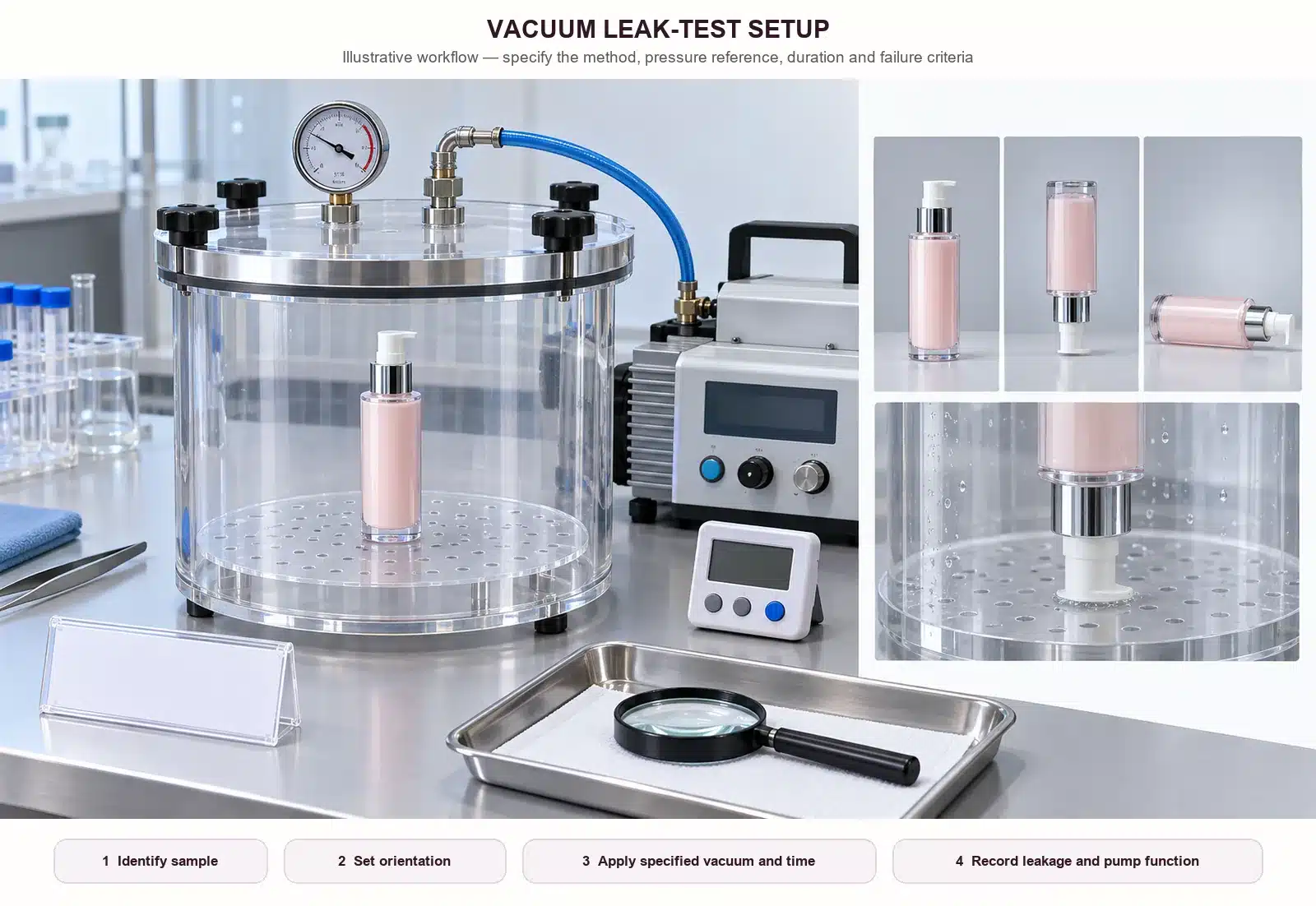
ASTM D4991-25 covers vacuum-method leakage testing of empty rigid containers under differential pressure conditions. That scope matters. An empty-container result can provide useful information about container integrity under the specified procedure, but it should not be presented as proof that your filled skincare product is compatible with the package for its entire shelf life. Those are different questions.
ASTM D5094/D5094M-24
ASTM D5094/D5094M-24 addresses gross leakage of liquids from certain rigid and semi-rigid containers using threaded or lug-style closures, within the scope defined by the standard. If your packaging has a different closure architecture — for example, a particular snap-on airless assembly — do not assume the method automatically applies. Ask the testing laboratory.
ISTA 3A
ISTA 3A takes the discussion beyond the retail bottle itself. It is a general simulation procedure for individual packaged products moving through parcel-delivery systems. That can matter when cosmetics are sold through e-commerce. The package being evaluated is no longer just: bottle + pump
It may be: filled bottle + lock/overcap + retail carton + inserts + shipping carton
That complete configuration can behave very differently in distribution. For palletised bulk shipments, another distribution test may be more appropriate. The laboratory should select a procedure that reflects how the goods will actually move.
Give the laboratory a test brief
This small change can save a surprising amount of confusion. Imagine two suppliers both return reports saying: PASS — No leakage.
Supplier A tested three empty bottles for a few minutes. Supplier B tested filled production-representative samples, in multiple orientations, after conditioning and transport simulation. Both documents contain the word “PASS.” They do not provide the same evidence. Before testing begins, define what is being approved. At minimum, the record should identify:
The exact samples
Record:
- formula version
- bottle model
- pump model
- material or resin specification where relevant
- component revision
- fill volume
- production or sample lot
If the supplier changes the pump, gasket, resin, decoration process or formula after approval, somebody should determine whether the previous test remains applicable.
How the package was assembled
Document relevant filling and assembly conditions. For example:
- fill quantity
- pump application
- torque where relevant
- snap assembly where relevant
- locking mechanism
- protective clip
- overcap
- liner
- filling instructions
An airless package assembled incorrectly can fail even when the individual components are perfectly acceptable.
What conditions were tested
The report should tell you enough to understand what actually happened. Depending on the project, this may include:
- test method
- method edition
- sample quantity
- orientation
- temperature
- conditioning
- pressure conditions
- duration
- vibration or distribution exposure
A number without a unit is not useful, and neither is the phrase “vacuum test” without an explanation of the test configuration.
What counts as a failure
Agree this before receiving the report. For example:
- external liquid visible
- loss of package integrity
- unintended dispensing
- actuator malfunction
- loss of prime
- bottle distortion
- unacceptable output variation
Otherwise, the buyer and supplier can look at the same result and reach different conclusions.
Include dispensing performance in the approval
A package can remain completely dry on the outside and still fail commercially. Suppose a facial cream passes its leakage test but the consumer needs fifteen pumps to prime the bottle. That is not a successful package. Or the pump works at first, but after storage it begins dispensing irregularly. Also a problem. For airless and standard lotion pumps, review:
- number of actuations required for initial priming
- dose per actuation
- consistency between actuations
- restarting after storage
- dispensing when used at different angles, where relevant
- end-of-pack evacuation
- actuator return
- visible formula accumulation
- clogging or drying around the outlet
If output is specified, make the measurement clear. Mass and volume are not interchangeable unless the relevant formula density is taken into account. This becomes material when a purchasing specification treats “0.5 g” and “0.5 ml” as equivalent even though the formula density has not been considered.
Recheck the finished pack after transport exposure
Cosmetics packaging is often approved while sitting neatly on a laboratory bench. Customers do not use it on a laboratory bench. Before it reaches them, the finished product may be:
- palletised
- trucked to a port
- loaded into a container
- exposed to temperature changes
- shipped internationally
- handled by a warehouse
- repacked for e-commerce
- moved through parcel networks
A pump that looks excellent in an empty sample can behave differently after these exposures. After an appropriate transport test, do not inspect only the carton. Open the package and check the product again. Look for:
- leakage
- actuator movement
- bottle damage
- loose closures
- unexpected dispensing
- loss of prime
- changes in pump performance
A clean outer carton does not prove that every dispenser inside still works correctly.
Build an approval file before ordering
For a serious private-label or OEM/ODM project, we recommend building a small approval file rather than relying on scattered messages between the buyer, packaging supplier and factory. A useful approval file can remain concise and include: 1. Component drawing or specification
Confirm dimensions, neck finish, pump configuration and other relevant construction details. 2. Product-contact material information
Know which materials are actually in contact with the formula. 3. Approved physical sample
Keep an identifiable reference sample whenever practical. 4. Filling and assembly instructions
Especially important for airless systems. 5. Formula compatibility or stability evidence
The report should identify which formula and package version were evaluated. 6. Leakage/performance test information
Look beyond the word “PASS.” 7. Decoration approval
Color, printing, coating, hot stamping and other decoration processes can introduce additional variables. 8. Change-control agreement
If a supplier changes a critical component after approval, the buyer should be informed. Change control is easy to overlook, but an approved sample means little if production later uses a different critical component.

Compare cost and MOQ on the same specification
For sourcing, packaging performance is only half of the decision. The commercial case matters as well. Airless packaging normally contains more specialised components and a more complex dispensing structure than a conventional lotion bottle. As a result, it will often cost more for a comparable capacity and finish. But comparing only the unit bottle price can be misleading. Ask both suppliers to quote the same project assumptions:
- capacity
- quantity
- material
- pump
- decoration
- colour
- mould requirements
- sample charges
- testing
- assembly
- secondary packaging
Also ask whether your chosen package requires special filling equipment or procedures. A slightly cheaper bottle that creates filling-line problems is not actually cheaper. MOQ can also change substantially depending on whether you are buying a stock model, requesting a custom colour, adding decoration or developing new tooling. So we would not recommend using a generic online statement such as: “Airless MOQ is X pieces.”
There is no meaningful universal number. Get the MOQ for the exact packaging configuration you intend to buy.
A practical five-step decision
If you are still undecided, work through the decision in this order.
Choose the formula first
Do not fall in love with a bottle before the formulation team has reviewed it. Start with:
- product type
- viscosity and flow behaviour
- sensitive ingredients
- preservation strategy
- expected shelf life
- fill size
Then define the user experience
Decide:
- desired dose
- one-hand use or not
- premium vs mass-market positioning
- expected product evacuation
- travel/e-commerce requirements
- retail presentation
Shortlist two or three packaging systems
Narrow the options before committing resources to testing.
Put the real formula inside them
Water can be useful for some limited packaging tests. It does not prove that your lotion, serum or cream will behave the same way.
Test before mass production
The winning package is not necessarily the most expensive or technologically impressive. It is the one that meets the agreed performance criteria with your formula and your distribution route at a commercially acceptable cost.
Three sourcing mistakes to avoid
1. Choosing airless because the formula is “premium”
Premium is a positioning decision, not a technical specification. If the package improves the product experience or supports the brand, fine. But understand why you are paying for it.
2. Approving packaging from photographs
Photographs are excellent for narrowing down shape, colour and styling. They cannot tell you what mechanism is inside. Ask for a component drawing, technical specification or sample that allows the structure to be confirmed.
3. Accepting a generic test report
If the test report cannot be connected to your formula, your packaging version and your production specification, its value is limited. Traceability matters.
Frequently asked questions
Is an airless pump always better than a lotion pump?
Airless packaging can be advantageous when reduced air exposure, high product evacuation or premium dispensing is important. A standard lotion pump can be the better option when simplicity, cost, larger capacities and broad packaging availability matter more. The correct choice depends on the formula and the commercial project.
Does airless packaging prevent oxidation?
Airless systems are designed to reduce repeated air exchange with the formula during dispensing, which can be useful where air exposure is a concern. That does not justify a blanket claim that any airless bottle will prevent oxidation. Formula stability should be evaluated with the selected finished package.
Does an airless bottle mean I can use fewer preservatives?
Do not make that decision from the package name alone. The microbiological safety and preservation strategy of the cosmetic product should be determined by the qualified formulation and safety teams using appropriate evidence. Special high-protection or preservative-free dispensing systems do exist, but their performance belongs to specific validated systems — not to every bottle described as “airless.”
Can I test the bottle with water?
Water may be useful for a limited test where the method permits it, but it does not establish that your intended cream or lotion is compatible with the package. For final packaging approval, test the actual formulation or a properly justified representative material under an agreed protocol.
Which bottle leaves less product inside?
A properly matched airless system can provide very high product evacuation because a piston or pouch moves with the product. However, results depend on the actual formula and package. Measure evacuation with your intended product rather than relying on a generic catalogue figure.
Are airless bottles leak-proof for international shipping?
The complete filled package should be assessed under test conditions appropriate to the intended distribution route. Pump protection, closure design, secondary packaging and carton configuration all matter.
Is airless packaging more expensive?
Usually, yes, when compared with a conventional lotion pump of similar capacity and decoration. But packaging should be compared as a complete project, including filling, decoration, testing, secondary packaging and expected order quantity.
What information should I send a packaging supplier?
The more complete the brief, the more useful the quotation and sample selection will be. Include:
- product type
- approximate viscosity or formula information available for review
- fill size
- target quantity
- target market
- desired packaging material
- airless or standard pump preference
- desired pump output if known
- decoration requirements
- shipping market or route
- documentation or testing requirements
If the formula is still under development, say so. A good supplier should know which decisions can be made now and which need to wait until the formula is confirmed.
Procurement FAQ: Qualifying Airless and Lotion Pumps
Can I use an airless pump for high-viscosity body butter?
Possibly, but the word “airless” does not confirm suitability. Shortlist a pump designed for high-viscosity formulas, then test the actual body butter at relevant storage and use temperatures. Record initial priming, dose consistency, restart after storage, actuator return and end-of-pack evacuation.
Is -0.08 MPa for 15 minutes a universal airless-bottle standard?
No. It can be written as a project-specific screening or acceptance condition only when the supplier or laboratory confirms that the method suits the package and test objective. The record must define whether samples are empty or filled, the pressure reference, orientation, duration, temperature and failure criteria.
What residual-product target should I put in the RFQ?
Define a measurable maximum residual after an agreed dispensing cycle with the actual formula. A target below 3% may be commercially useful for some premium treatments, but it is a buyer requirement to validate, not a guaranteed property of every airless bottle.
What evidence should the supplier return after compatibility and leakage testing?
Request the component drawing and product-contact materials, identifiable formula and package versions, sample quantity, assembly conditions, test protocol, raw observations, pass/fail criteria, photographs where available, deviations, approval date and change-control commitment.
Approve the combination, not the label
Airless packaging is not automatically “better packaging.” It is a different dispensing system. For the right skincare formula, it can provide excellent formula protection, controlled dispensing, strong product evacuation and a premium user experience. Modern airless systems are available in a wide range of designs, including mono-material, refillable and high-protection configurations. For many everyday lotions and personal-care products, however, a conventional lotion pump remains a very practical solution. Define the formula and pack requirements in your body lotion and personal care sourcing brief. What matters most is not which bottle wins a comparison chart.
It is whether the actual formula + actual bottle + actual pump + actual filling process + actual shipping configuration work together. That is the combination buyers should approve.
Source airless and lotion pump packaging in Guangzhou
YIFA PLAZA connects international buyers with cosmetic packaging suppliers, OEM/ODM manufacturers and beauty supply-chain resources in Guangzhou. If you are comparing an airless bottle with a conventional lotion pump, send us the project rather than just a photograph. Useful information includes:
- product category
- formula type
- target capacity
- estimated order quantity
- sales market
- desired packaging style
- customization requirements
- testing or compliance documents required
Our team can use the brief to narrow the supplier and packaging options before you move into samples and compatibility testing. Review the cosmetic packaging sourcing page or request supplier matching. Need packaging options for your product?
Send your sourcing requirements to YIFA PLAZA for supplier matching and OEM/ODM coordination in Guangzhou.
Need supplier options for this product?
Share the product type, target quantity, destination market, customization and required documents. Our team will compare suitable wholesale, private-label and OEM/ODM options in Guangzhou.
Send your sourcing requirementsContinue your research
Related buying guides
Custom Skincare Formulation: Write the Brief Before Requesting Samples
Decide whether your skincare project needs a new formula, a modification or a private label route. Prepare a comparable brief and track…
Read the guide
How to Verify a Cosmetic Manufacturer in China
A practical due-diligence framework for verifying a Chinese cosmetic manufacturer, including licence checks, ISO 22716 evidence, factory audits, batch traceability and destination-market…
Read the guide
Low-MOQ Cosmetic Packaging: What Is Included in the Minimum Order?
A buyer-side guide to comparing low-MOQ cosmetic packaging quotations, including containers, closures, colour, decoration and sample specifications.
Read the guideSupplier matching
Tell us what you need to source
Send your product category, expected quantity, sales market and required documents. We will organize the brief before matching suitable suppliers.